

Industrial Thermal Insulation for Oil & Gas Facilities
A concise guide to material selection, CUI prevention, installation and energy efficiency
Industrial thermal insulation helps control heat transfer between process equipment and the surrounding environment. In oil and gas facilities, it supports process temperature control, energy efficiency, personnel protection and asset integrity. A complete system includes the insulation material, attachment components, protective cladding, joints, seals and inspection provisions. Selection must reflect operating conditions and project specifications.
Key Takeaways: Oil & Gas Thermal Insulation at a Glance
- Engineered System Approach: Performance depends on matching insulation material, coatings, vapour barriers, cladding, fasteners, mastics, sealants, and inspection access—not insulation thickness alone.
- Material Selection by Duty: Mineral wool (hot duties), cellular glass (selected hot/cold closed-cell duties), aerogel blankets (space/weight constraints), and PUR/PIR (suitable lower-temperature duties) must always be verified against current datasheets and test reports.
- Economic Thermal Design: Calculate thickness from actual process temperatures, equipment geometry, ambient/wind conditions, operating hours, and thermal bridges at supports, valves, and flanges.
- CUI Prevention: Combine suitable protective coatings, water-shedding cladding, sealed penetrations, and risk-based inspection at low points, supports, and coastal exposures.
- Lifecycle & Handover Control: Base energy and lifecycle evaluations on site-specific data and maintain a complete insulation register with material certificates and as-built documentation.
1. Key Applications
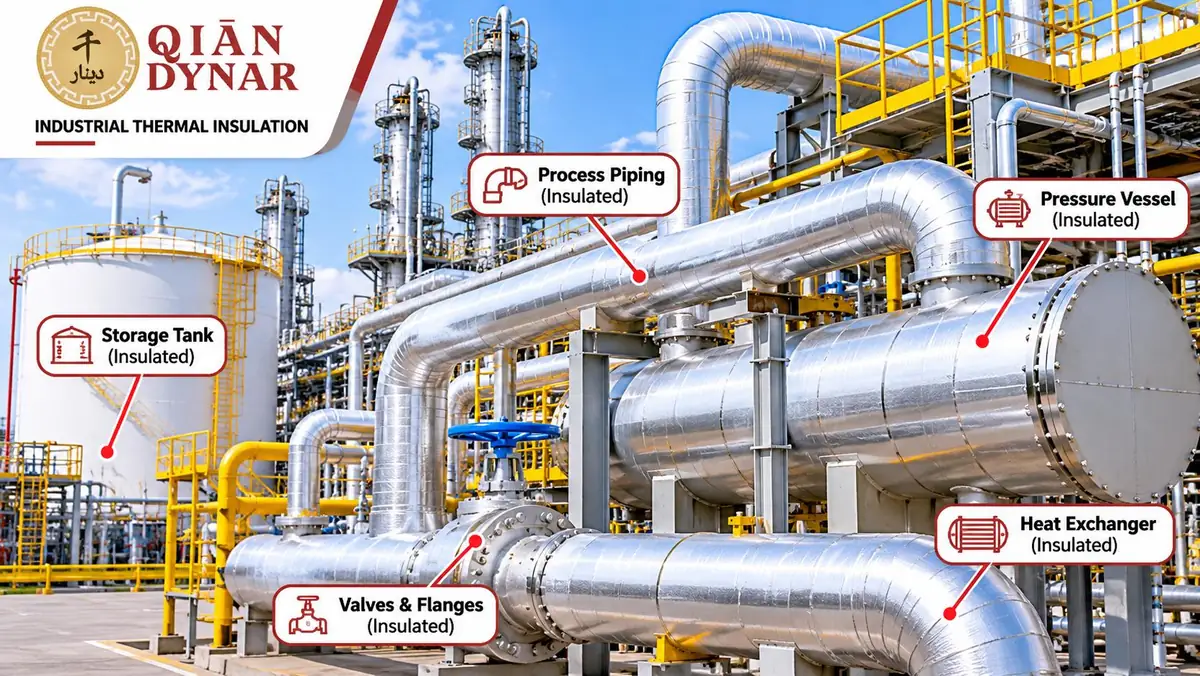
Insulation is used on process and utility piping, pressure vessels, separators, storage tanks, heat exchangers and other equipment. Hot systems may need to retain process heat or maintain fluid temperature; cold systems may need to limit heat gain and prevent condensation. Offshore and marine facilities require particular attention to salt-laden air, wind-driven rain, vibration, mechanical damage and restricted maintenance access. Supports, valves, flanges, nozzles and penetrations need carefully designed details.
2. Choosing the Right Material
Material selection depends on design temperature, thermal conductivity, water behaviour, compressive strength, fire requirements, chemical compatibility, geometry and lifecycle cost. Mineral wool is widely used for hot industrial piping and equipment. Cellular glass offers a rigid closed-cell structure and low water absorption for selected hot or cold duties. Aerogel blankets can help where space or weight is limited. PUR and PIR are considered for suitable lower-temperature and selected industrial applications, subject to product-specific temperature, fire, facing and moisture limits. No material should be chosen from its name alone; review current datasheets and test reports.
3. Thermal Design and Thickness
Insulation thickness should be calculated using actual process temperatures, pipe or vessel dimensions, ambient conditions, wind, operating hours and the required surface-temperature or heat-loss target. Heat moves by conduction, convection and radiation. Increasing thickness generally reduces heat loss, but also increases material, cladding and installation costs. The economic thickness balances these costs over the expected service life. Designers must also address thermal bridges at supports, shoes, hangers, valves and flanges. For cold service, continuous vapour control is essential to limit condensation.
4. Corrosion Under Insulation (CUI)
CUI occurs when moisture reaches and remains on metal beneath insulation. Water can enter through damaged cladding, open seams, poor terminations, penetrations or support details; condensation and repeated wet-dry cycles can also contribute. Prevention starts with suitable protective coatings, compatible insulation and accessories, water-shedding cladding details and sealed penetrations. Inspection should be risk-based, prioritising damaged areas, supports, low points, coastal exposure and susceptible operating conditions. Insulation alone does not prevent corrosion; coating, moisture exclusion, inspection and maintenance must work together.
5. Installation and Weatherproofing
Before installation, confirm that the substrate is clean and dry, coating inspections are accepted and required testing is complete. Verify material identity, condition and certificates. Fit insulation closely without excessive compression or gaps, stagger joints where specified, and detail elbows, tees, valves and flanges correctly. Keep vapour retarders continuous on cold systems. Cladding should shed water, accommodate thermal movement and protect against weather and impact. Use compatible bands, fasteners, mastics and sealants. Never cover wet insulation, unresolved leaks or unaccepted coatings.
6. Inspection and Maintenance
Routine inspections should look for loose or missing cladding, open laps, damaged sealant, corrosion stains, water marks, exposed insulation, failed bands and settlement. Pay special attention to low points, supports, penetrations and locations exposed to spray or wash-down. When insulation is removed, document its condition, the coating condition and substrate findings, and follow the site's approved inspection procedure. Thermal imaging can help identify abnormal temperature patterns but is not a substitute for required integrity inspections. Maintain an insulation register with material, thickness, installation date, inspection history and repairs.
7. Energy Efficiency and Lifecycle Value
Well-designed insulation can reduce heat loss from hot systems and heat gain into cold systems. Quantify benefits using site-specific data such as operating hours, energy prices, temperatures, installation cost, access requirements and expected service life. Include maintenance, repair, downtime and replacement in lifecycle comparisons. For cold systems, a failed vapour barrier can increase heat gain and cause condensation. Avoid generic energy-saving or emissions claims unless supported by measured or calculated project data.
8. Procurement Checklist
Before ordering, define service and design temperatures, equipment dimensions, insulation material and thickness, cladding, coating and environmental requirements. Review datasheets, test reports, certificates, thermal conductivity, service limits, mechanical properties, water absorption and fire performance. Confirm compatibility of accessories and sealants. Coordinate engineering, procurement, construction, inspection and operations. At handover, retain approved drawings, material certificates, inspection records, product data, maintenance recommendations and as-built details.
Conclusion
Industrial insulation is a complete engineered system—not simply a layer of material. Reliable performance depends on correct material selection, thermal design, moisture control, corrosion prevention, installation quality and planned inspection. Qian Dynar Sdn. Bhd. lists insulation materials including Mineral Wool, Cellular Glass, Aerogel Blankets, PUR and PIR, together with cladding, fasteners, tapes, mastics and sealants. Project teams can review the product range at Qian Dynar Industrial Insulation Materials and confirm suitability against project specifications and current manufacturer documentation.
Specifying Thermal Insulation for an Oil & Gas Project?
Review Qian Dynar Sdn. Bhd.’s full industrial insulation materials, cladding, accessories, and mastics/sealants catalogue, or contact our technical team for current datasheets, test reports, and project quotations.